3 August 2026
Opening a Swiss Corporation (Aktiengesellschaft)
The article provides information about the Swiss SA or AG. You can ask our Swiss experts in company formation about the registration of a corporation.

In Switzerland companies fall under the Civil Code or the Code of Obligations and are usually registered with the Commercial Register of the canton they were set up in. Due to the country’s advantageous conditions for foreign investments, foreign businessmen are usually inclined to register stock corporations (Aktiengesellschaft or Societe Anonyme) in Switzerland.
Below, our company formation specialists in Switzerland explain the main requirements for opening a corporation. Also known as the Swiss AG or SA, this legal entity can be used for multiple purposes. Our agents can help you register it.
Incorporation procedure for Swiss stock companies
The first step when incorporating a stock company in Switzerland is to choose a name for the company and submit it for approval with the Commercial Registry. Then a public deed must be prepared by a public notary based on the passports of all the owners and the Articles of Association of the company. The registration of a company in Switzerland can take up to 20 working days.
| Quick Facts | |
|---|---|
| Applicable law | – Company Act, – Stock Corporation Law 2023 |
Minimum number of shareholders | The stock corporation must have at least one shareholder. |
Minimum number of directors | 1 |
| Resident director required (YES/NO) | Yes, at least one person authorised to represent the company (board member or manager) must be a Swiss resident. |
| Local address required (YES/NO) | Yes, a Swiss address is required. |
| Minimum share capital | CHF 100,000, of which at least 20% of each share and at least CHF 50,000 must be paid upon registration. |
| Local bank account required (YES/NO) | Yes |
| Uses | The stock company is suitable for large operations and trading on stock exchanges. |
| Liability of the shareholders | The liability of the shareholders is limited to their participation to the capital of the AG. |
| Visit required for incorporation (YES/NO) | No, the entity can be registered through a proxy. |
| Taxation regime | Corporate tax on the worldwide income |
| Corporate tax rate | 8.5% federal tax + cantonal corporate tax applied at a local rate |
| Audited financial statements required (YES/NO) | Yes |
| Advantages | – it is one of the most popular business forms in Switzerland, – it can also be used by foreign companies, – quick registration process |
| Registration support (YES/NO) | Yes, we can assist with the establishment of a Swiss stock corporation. |
The following step is to submit the following documents with the competent cantonal commercial register:
- the deed of incorporation notarized by the public notary;
- the company’s Articles of Incorporation;
- a statement that the start-up capital has been deposited issued by the bank;
- a document that states the appointment of the directors and their consent;
- a statement of the shareholders;
- an application form with the notarized signature of the company’s representative.
If you want to open a Swiss SA, our advisors are at your service. A firm is required to undergo a comprehensive audit in accordance with Swiss Commercial law if it achieves two of the three requirements for public company status in two consecutive fiscal years: a balance sheet total of CHF 20 million, revenue of CHF 40 million, and 250 full-time workers. A Swiss audit expert and a supervised audit firm must be chosen to undertake a thorough audit for a public business. You can obtain more information about audits from our Swiss accounting company.
Requirements for setting up a Swiss AG
In order to open a Swiss stock corporation investors take into account that the minimum number of shareholders is one and the minimum start-up capital is 100,000 CHF of which at least 20% but no less than 50,000 CHF must be deposited in a bank account upon the incorporation of the company. The deposited share capital will be blocked by the bank until the company receives its certification of incorporation. The stock corporation in Switzerland is only allowed to issue bearer shares if it has listed shares or the bearer shares are intermediated securities (since 1 November 2019). Other types of shares in the Swiss stock company are preference shares and voting or non-voting shares. The shareholders will be held liable for the company’s obligations and debts to the extent of their capital contributions.
The Swiss AG must meet the following organizational requirements:
- it must have one or more shareholders;
- it must also have a board of directors;
- at least one auditor must be appointed by the shareholders.
If the company has no more than 10 full-time positions on annual average, the shareholders can agree to not appointing an auditor.
The Swiss SA must also have at least one director that should have Swiss residency and in case more directors are nominated, there is no majority-residence requirement. However, directors can have any nationality. A stock corporation is not allowed to have corporate directors. With respect to the management, the company can also have various officers in key management positions optionally. These do not have shareholders, however, it is possible.
At least one member of the board of directors, management officer, or signatory with sole signature authority (or two with joint signing authority) must be a resident of Switzerland.
Other requirements for the Swiss SA are that it must have a registered office and an auditor. Annual accounts must be approved by the general meeting each year; they are not filed with the commercial register (only listed companies and bond issuers must publish them). Swiss stock corporations that have an annual return lower than 20 million CHF or a balance sheet lower than 10 million CHF or less than 200 employees is not required to prepare consolidated accounts (thresholds: CHF 20m balance sheet, CHF 40m revenue, 250 FTE).
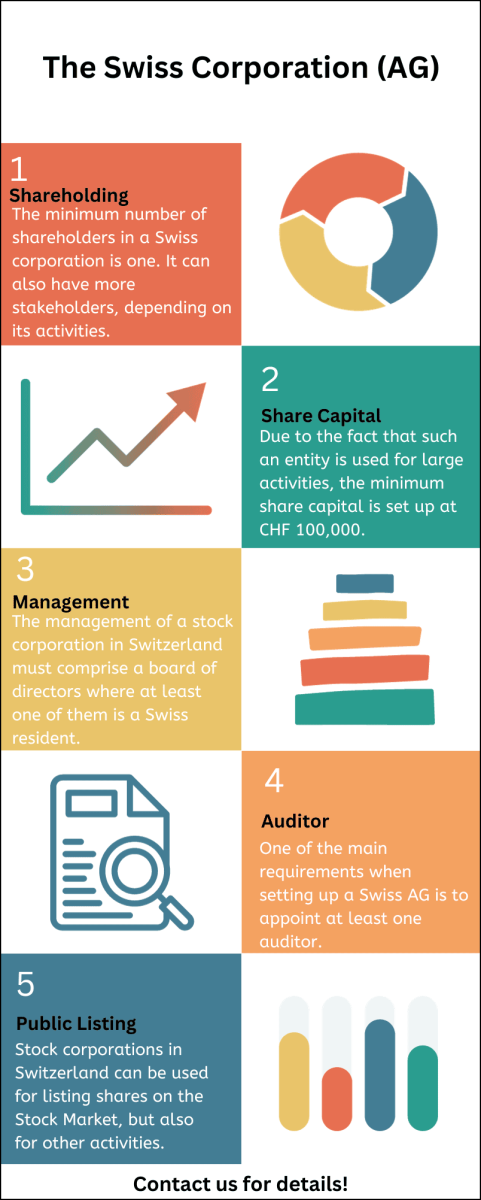
Here is an infographic on this subject:
Trading name and registered address requirements
Setting up a SA in Switzerland implies meeting various requirements, among which having a unique name and a registered address in this country. These apply to all types of Swiss companies, which is why two of the first steps to complete when registering this business form is reserving the company name (at least 3 names must be proposed in order to ensure its validation) and a registered address must also be submitted with the Trade Register.
Because the registered address can be more difficult to find which is why the virtual office can be a suitable option to start with, especially since it is permitted.
Our specialists can provide more information on the virtual office options available in Swiss cities.
Shareholding and management requirements in a Swiss SA
Compared to the private limited liability company (GmbH), which is much simpler in terms of registration requirements, the Swiss SA implies more stringent requirements. For example, it needs at least one shareholder, who can be natural person or company and has no restriction requirements in terms of foreign ownership.
When it comes to the management, however, the requirements are more complex than those of a GmbH, as the corporation needs a Board of Director who can appoint managers to handle day-to-day operations. The board may have a single director, and at least one of them must be Swiss resident. EU/EFTA nationals can obtain a permit relatively easily; non-EU nationals are subject to annual quotas and must show an economic interest for Switzerland.
Another important requisite to keep in mind is that this business form cannot have corporate directors.
The creation of a corporation in Switzerland is not complicated, as the procedure is the same as for any other type of entity. The minimum share capital and management requirements, however, imply a little more effort that can be surpassed with good planning.
Our company registration consultants in Switzerland can help you create this business form just as simple as a GmbH.
The capital structure of the Swiss stock corporation
The joint stock company or SA as it is shortly referred to in Switzerland is usually employed for large operations. This means that it requires a higher amount as share capital. The minimum necessary is established by the Company Act and it is CHF 100,000. Out of these, at least 20% of each share and no less than CHF 50,000 must be deposited upon registration. The capital can be denominated in cash or kind.
The Swiss AG’s share capital can be denominated in CHF or foreign currency, depending on the shareholders’ decision. From this point of view, it is important to note that both the commercial and financial reporting requirements must be made in the same currency. It is not uncommon for an SA to have the capital denominated in US dollars, euros, even Japanese yen. The amount must be the equivalent in Swiss CHF.
It is worth noting that cryptocurrencies are not accepted as currency for the share capital of such a company.
The capital is divided among the participants, better said the shareholders whose minimum number is 1 while there is no cap on the maximum of shareholders. These can issue the following types of shares:
- registered shares;
- non-voting shares with nominal value also known as participation certificates.
The nominal value of one share only needs to be greater than zero.
With respect to share transfers at company levels, there are no legislative limits on the transferability available for both registered shares and participation certificates. However, a shareholders‘ agreement may contain contractual restrictions on transferability.
Compared to the private limited liability company, the stock enterprise is more complex both in terms of establishment and operations it can carry out. This is why if you want to set up a company in Switzerland by using this legal form, we advise using specialized services. Our agents can offer full business incorporation services in this sense.
As a general rule, the registration procedure for any type of company is approximately 3 weeks. However, it should also be noted that having a local entity requires setting up a Swiss bank account which can take longer. This is also the case of the Swiss AG for which it can take up to 4 weeks to open a corporate account.
If you decide to open a company in Switzerland as an AG and need support, you can rely on our local advisors who can start the registration process in the canton you choose.
Licensing requirements for a Swiss SA
When it comes to obtaining business permits and licenses there are no differences in terms of legal entities, as the same apply to both Swiss GmbHs and SAs. The necessary licenses must be obtained with the authorities in charge of the industries in which the respective company will operate.
The Swiss stock corporation is usually suitable for activities in telecommunications and other important fields which require important financial resources, and which are also highly regulated.
No matter the type of activity you want to undertake, our officers can provide you with the necessary details on the licenses you need to obtain for your Swiss company.
Taxation of the Swiss AG
The taxation of companies in Switzerland varies between about 11.9% and 20.5% depending on the canton they were set up in. The tax is formed by federal, cantonal and municipal rates. However, companies can apply for tax deductions so the tax rates are usually lower than the rates published in the Swiss tax code.
The withholding tax on dividends in Switzerland is 35%, but according to tax treaties Switzerland has signed with other countries dividends taxation can be reduced to 0%. Royalties are not subject to withholding tax, but interest on bonds and bank deposits is subject to 35% withholding tax.
Accounting requirements for Swiss corporations
A Swiss AG has a duty to keep accounting records. The accounting records must be kept in Swiss francs or in the currency essential for the business and be accessible to the local authorities. The creation of annual financial statements is also required. If a parent business meets at least two of the following requirements for 2 consecutive years, it is not required to prepare consolidated financial statements:
- the balance sheet total is below CHF 20 million;
- the company has a yearly turnover of less than CHF 40 million;
- the business has an average of less than 250 full-time employees.
Also, an AG’s yearly accounts must be audited in accordance with Swiss law. However, if two of the following thresholds are not exceeded in two consecutive years, only a limited audit (or, with up to 10 FTE and all shareholders' consent, an opting-out) may be granted:
- the balance sheet total is below CHF 20 million;
- the annual turnover is less than CHF 40 million;
- the average number of full-time employees is below 250.
We are also the service of your company with accounting services. Feel free to address our accountant in Switzerland about the tailored packages for large enterprises.
The uses of a Swiss corporation
Because of the share capital requirements, the corporation is more suitable for large projects that imply a higher degree of commitment. For example, international companies seeking to establish their headquarters in Switzerland in order to service a larger region (for example all European Economic Area countries) can use the SA as a legal vehicle. Then, it can also be employed for the creation of holding company which has a large portfolio of assets.
A particularity of the Swiss SA is that is one of the most appropriate legal forms for creating investment vehicles. Switzerland is one of the most renowned investment centers in the world and in Europe and many investment funds are based here. Thanks to the registration requirements and stringent regulations imposed on this business entity, as well as the share capital, it is often the perfect choice for setting up an open or closed-ended investment company.
The Swiss AG vs. the Swiss GmbH
The AG and GmbH, meaning the stock corporation and private company, are the two business entities that offer limited liability to their shareholders. There are also other similarities between the two of them, however, there are also important differences when it comes to choosing one or the other.
An interesting fact about the Swiss AG is that it is the preferred business form of investors, compared to other European countries. On one side, this has to do with Switzerland’s financial profile in terms of doing business, and on the other it offers enhanced protection to its shareholders.
The Swiss GmbH, on the other hand, is more suited to small and medium-sized enterprises that try to enter the market with operations that are more popular in other European jurisdictions.
If you want to open a company in Switzerland under the form of a SA or AG and need assistance, you can rely on our local agents.
You can rely on our agents if you want to open a company in Switzerland through a SA no matter the uses intended. Below, you can also watch a video on this type of company:

What other aspects are there to consider about the Swiss corporation?
The Swiss SA is subject to various requirements imposed by the Trade Register and Tax Authority. Among these, here are the most important:
- such companies must pay the corporate tax, as well as the value added tax which is levied at a standard rate of 8.1%;
- the shareholders must hold an annual general meeting no later than 6 months after the end of the financial year;
- the par value of a share in Swiss SA only needs to be greater than zero;
- the company can issue registered shares as long as 20% of their value has been paid;
- its share capital may be denominated in Swiss francs or, since 2023, in GBP, EUR, USD or JPY.
Advantages of an AG company in Switzerland
The Swiss SA has a few important advantages compared to other legal forms. Among them, our consultants remind the following:
- shareholders are not published in the commercial register (beneficial owners must however be reported to the non-public transparency register since 1 October 2026), in accordance with the abbreviation SA which comes from French Societe Anonyme;
- it offers limited liability to the shareholders, liability that is strictly related to their participation in the company’s capital;
- it can obtain funds easier, by issuing shares for sale in accordance with their needs;
- it is also easy to regulate various types of restrictions with the help of this business form, no matter if they are commercial or contractual;
- it has a good reputation in Switzerland;
- it can be traded or not on the Stock Exchange, depending on the stakeholders’ choice;
- financial statements must be made public only for Swiss AGs that trade on the Stock Exchange.
In case you need assistance in filing such a company’s financial statements, you can rely on our accounting company in Switzerland.
Our Swiss company formation agents are at your service with complete support in setting up an AG company.
If you want to start a business and need details about the Civil Code or the taxation system you can contact our specialists in company formation in Switzerland.